

Cover-Up Tattoos: What's Possible (and What's Not)
Got a tattoo you’re pretending not to see every time you look in the mirror? Good news: bad ink doesn’t have to be a lifelong commitment. Learn how custom cover-up tattoos use color, creativity, and smart design to turn tattoo regrets into something you’re proud to wear.

Have a tattoo you no longer love? You’re not alone and you’re definitely not stuck with it. Bad tattoos don’t have to spend their lives hidden under long sleeves and regret.
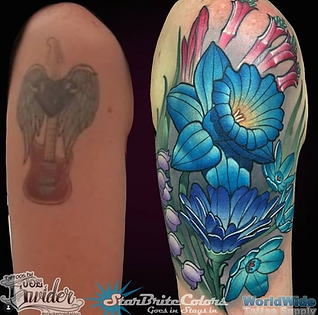
A well-designed cover-up tattoo can transform old, faded, or poorly done ink into something you’re proud to show off. And while laser removal may sound futuristic, it’s often expensive, painful, and still leaves behind a faint reminder of the past.
If you’re searching for a cover-up tattoo artist in Connecticut, let’s break down what’s possible, what’s realistic, and how color and new school tattoos can give your ink a second life.
What Is a Cover-Up Tattoo?
A cover-up tattoo is exactly what it sounds like - a new tattoo designed to work with your existing ink to disguise it within a fresh design. The goal isn’t just to hide the old tattoo like it never happened (because hey, we all have a past), but to transform it into something intentional, bold, and well-executed.
Cover-ups are commonly done for tattoos that are:
Faded or blown out
Outdated in style (looking at you, early 2000s tribal)
Names, symbols, or designs that no longer fit your life
Technically… let’s say “learning experiences”
What Makes a Tattoo a Good Candidate for a Cover-Up?
Not all tattoos are created equal and the same goes for covering them up. The good news? Most tattoos can be improved dramatically with the right plan.
Size & Placement
Smaller tattoos offer more creative freedom. Bigger tattoos can still be covered, but they usually require smart design choices and a little artistic finesse (don’t worry, that’s my thing).
Darkness & Saturation
Dark, heavily saturated tattoos need designs with strong structure or rich color to properly mask what’s underneath. This is where bold color palettes really earn their paycheck.
Age of the Tattoo
Older tattoos are often easier to cover because ink naturally fades over time. Yes, even that one you swore would “last forever.”
Skin Condition
Healthy skin with minimal scarring allows for smoother blending and cleaner results. Skin that’s been through a lot may just need a little extra planning.
Bottom line: a consultation is the fastest way to figure out what will work best for your tattoo.
Why Color & New School Styles Work So Well for Cover-Ups
As a color and new school tattoo artist in Connecticut, I specialize in styles that don’t just hide old tattoos, they overpower them (politely, of course).
Color Tattoos
Highly saturated colors help camouflage old ink
Layering creates depth and visual distraction
Perfect for florals, animals, illustrative designs, and bold concepts
New School Tattoos
Thick outlines that don’t mess around
Dynamic movement that breaks up old shapes
Creative freedom to completely reimagine the piece
Translation: these styles don’t whisper over old tattoos. They confidently talk over them.
What a Cover-Up Can (and Can’t) Do
✔️What's Possible
Fully disguise many old or unwanted tattoos
Significantly improve poorly done work
Replace regret with something meaningful (or just really cool)
❌What to Keep in Mind
Cover-ups are usually larger than the original tattoo
Very dark tattoos require bold designs
Some tattoos may benefit from light laser fading before covering
If someone tells you anything can be covered with no limitations… that’s your cue to politely back away.
The Cover-Up Process: What to Expect
Consultation - We review the existing tattoo, talk goals, and figure out what’s realistic
Custom Design - Your new tattoo is designed specifically to work with what’s already there
Tattoo Session - Strategic layering, clean lines, and careful execution
Aftercare - Because even the best tattoos need a little TLC
I make sure you’re comfortable, informed, and confident every step of the way.
Planning Your Cover-Up Tattoo in New Milford, CT
If you’re in New Milford or nearby towns like Danbury, Brookfield, or Sherman, winter is actually a great time to plan a cover-up:
Easier scheduling
Less sun exposure while healing
Time to plan instead of rushing into something you’ll regret again (we’re breaking cycles here)
Explore More Custom Tattoos



Written by CrackerJoe Swider
Joe Swider, better known as Cracker Joe, is a custom tattoo artist based in New Milford, Connecticut, specializing in bold color, new school, illustrative, and creative cover-up tattoos. Whether it's a favorite movie character, an original creature, or transforming an old tattoo into something completely new, Joe enjoys taking unusual ideas and turning them into tattoos that are uniquely yours.
With years of experience and a passion for custom artwork, Joe believes every tattoo should tell a story, not come from a catalog. His approach is collaborative, honest, and focused on creating designs that fit both your vision and your body.
When he's not at the shop, Joe is usually spending time with his wife and two kids, going down rabbit holes watching alien and Bigfoot documentaries, or dreaming up his next off-the-wall tattoo idea. If your concept is a little weird, wonderfully nerdy, or completely original, he'll probably be just as excited about it as you are.
Have Questions About Cover-Up Tattoos?
How do I know if my tattoo is a good candidate for a cover-up?
The best way is through a consultation. Your artist can look at the size, color, age, and placement of the tattoo and help create a realistic plan. Sometimes the answer is a full transformation - sometimes it’s a little strategic planning first.
Are cover-up tattoos more painful?
Not necessarily. Pain depends more on placement, size, and your personal tolerance. Areas with scarring or previous tattoo work may feel different, but a skilled artist will work with your skin and make the process as comfortable as possible.
Can color tattoos cover black ink?
In many cases, yes. Bold colors, strong contrast, and smart design choices can help transform older tattoos. However, very dark or heavily saturated tattoos may require a more strategic approach - and occasionally lightening treatments before tattooing.
Are cover-up tattoos bigger than the original tattoo?
Usually, yes. A successful cover-up needs room to work. A larger design gives your artist more options for blending, disguising old ink, and creating something that looks intentional instead of simply covering something up.
Can any tattoo be covered up?
Most tattoos can be improved or transformed, but every cover-up has limitations. Size, darkness, placement, and the condition of the existing tattoo all affect what’s possible. A consultation is the best way to determine the right approach.


Ready to Upgrade an Old Tattoo?
Your old tattoo served its purpose, even if that purpose was “teaching you what not to do.” With the right design and the right artist, a cover-up can become your favorite piece.
👉Browse my portfolio 👉Book a consultation
📍 Located in New Milford, CT. DM or book online to schedule a consultation.
Specializing in color, new school, and cover-up tattoos
Your tattoo history is safe here. Let’s make your next one something you actually love.